
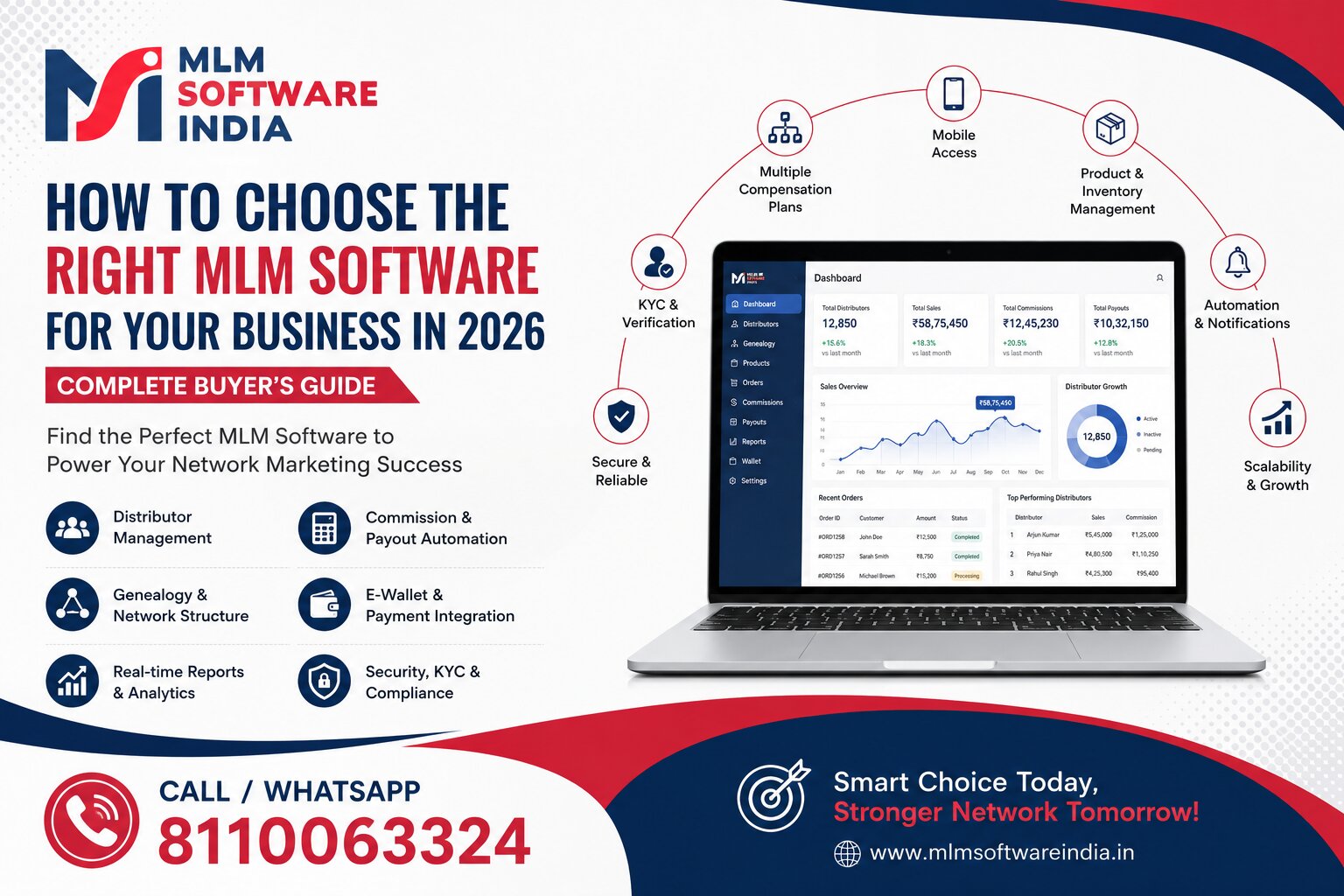
Choosing the right MLM software is an important decision for any direct selling or network marketing business. The software you select can influence how efficiently you manage distributors, calculate commissions, track sales, process payouts, handle customer data, and scale your network.
Modern MLM platforms go beyond basic genealogy and commission calculations. They can connect distributor management, e-commerce, payments, CRM, reporting, mobile applications, automation, and compliance workflows in one system. Current buyer guidance also emphasizes compensation-plan flexibility, scalability, integrations, security, and total cost of ownership when evaluating MLM software.
For businesses searching for MLM software in Thrissur, the right approach is not to choose a platform simply because it has the longest feature list. Instead, evaluate whether it actually fits your compensation plan, business model, distributor experience, technical requirements, budget, and future growth.
What Is MLM Software?
MLM software is a business management platform designed to automate and manage the operations of a multi-level marketing or direct selling organization.
Depending on the platform, it can manage:
- Distributor registration
- Sponsor and genealogy management
- Compensation plans
- Commission calculations
- Rank management
- Product and order management
- E-wallets and payouts
- Customer management
- KYC workflows
- Reports and analytics
- Notifications
- Mobile applications
- Payment integrations
- E-commerce integrations
- Distributor training
- CRM and lead management
The main purpose is to replace disconnected spreadsheets and manual processes with a centralized system that provides better operational control.
Why Is Choosing the Right MLM Software Important?
The wrong software can create problems as your network grows.
For example, a platform may initially work well with a small number of distributors but become difficult to manage when transaction volume increases. Other problems can include inaccurate commission calculations, limited compensation-plan flexibility, poor reporting, weak integrations, or an inadequate distributor interface.
The right platform should support your current business requirements while providing a practical path for future expansion.
A good MLM software solution can help businesses:
- Automate repetitive processes
- Reduce manual calculation errors
- Improve distributor visibility
- Speed up commission processing
- Centralize business information
- Improve reporting and decision-making
- Support multiple sales channels
- Enhance distributor experience
- Scale operations more efficiently
Step 1: Understand Your Business Requirements
Before comparing software vendors, document what your business actually needs.
Ask yourself:
- What products or services do we sell?
- How many distributors do we currently have?
- How many distributors do we expect in the next three to five years?
- Which countries or regions will we operate in?
- Which compensation plan do we use?
- How are commissions calculated?
- Which payment methods do distributors use?
- Do we need a mobile application?
- Do we need CRM integration?
- Do we need e-commerce integration?
- Will we require multiple languages or currencies?
- Do we need blockchain or cryptocurrency functionality?
- What compliance and data-protection requirements apply to our business?
Creating this requirements document before speaking to vendors makes software comparisons much easier.
Step 2: Check Compensation Plan Compatibility
The compensation engine is one of the most important components of MLM software.
Your software should accurately implement the rules of your compensation plan rather than forcing you to change your business model to fit the platform.
Common compensation structures include:
- Binary
- Unilevel
- Matrix
- Generation
- Board
- Stair-Step
- Hybrid
- Custom compensation plans
Important questions to ask a vendor include:
- Does the platform support my exact compensation plan?
- Can commission rules be configured without extensive custom development?
- Can the system handle rank qualifications?
- Can it manage bonuses and incentives?
- Does it support carry-forward or spillover rules where applicable?
- Can commission calculations be audited?
- Can the vendor demonstrate the system using our actual compensation rules?
Current buyer guidance recommends testing software against real compensation rules rather than relying only on a standard product demonstration.
Step 3: Evaluate Distributor and Genealogy Management
Distributor management is another core requirement.
The platform should provide a clear view of your entire network, including sponsors, downlines, ranks, activity, and account status.
Look for features such as:
- Distributor registration
- Sponsor management
- Genealogy trees
- Placement management
- Distributor profiles
- Rank tracking
- Team performance
- Distributor status
- Replicated websites
- Distributor dashboards
- Lead management
- Communication tools
A good genealogy system should make it easy for both administrators and distributors to understand network relationships.
Step 4: Examine Commission and Payout Automation
Manual commission calculations can become increasingly difficult as the organization grows.
Your MLM software should automate:
- Commission calculations
- Bonuses
- Rank incentives
- Matching commissions
- Payout qualification
- E-wallet updates
- Withdrawal requests
- Payout reports
It should also provide an audit trail so administrators can understand how a particular commission was calculated.
Ask the vendor to demonstrate a complete commission cycle using sample orders and actual compensation rules.
This is more useful than simply viewing a list of commission-related features.
Step 5: Look for Strong E-Commerce and Payment Integration
Modern direct selling businesses often operate through online stores, mobile applications, payment gateways, subscriptions, and other digital channels.
Your software should integrate with the systems your business already uses or plans to use.
Potential integrations include:
- Payment gateways
- E-commerce platforms
- CRM systems
- Accounting software
- Inventory systems
- Email platforms
- SMS providers
- WhatsApp or messaging systems
- Identity-verification services
- Analytics tools
Integration capabilities are increasingly important because MLM software does not necessarily operate in isolation. Current software research highlights integrations with e-commerce, payment, training, and analytics tools as part of the broader MLM technology ecosystem.
Step 6: Check KYC, Security, and Compliance Features
MLM platforms can store significant amounts of distributor, customer, transaction, and financial information.
Security should therefore be a major part of your buying decision.
Evaluate whether the software provides:
- SSL/TLS protection
- Role-based access control
- Strong authentication
- Secure password policies
- Audit logs
- Data backups
- Access monitoring
- Secure payment integrations
- Document-management controls
- Privacy controls
If KYC is required for your business, check whether the platform can support document collection, verification workflows, approval statuses, and appropriate recordkeeping.
Do not rely only on statements such as “secure software.” Ask vendors to explain their security architecture, backup procedures, access controls, and incident-response processes.
Step 7: Consider Mobile Experience
Distributors increasingly expect to manage their business from smartphones.
A modern Network Marketing Software platform should provide a responsive web dashboard or dedicated mobile application.
Important mobile functions may include:
- Commission tracking
- Genealogy viewing
- Order management
- Distributor registration
- Customer management
- Notifications
- Rank tracking
- Sales reports
- E-wallet access
- Training resources
Before choosing a platform, test the actual mobile experience rather than assuming that a desktop platform will automatically provide a good mobile experience.
Step 8: Evaluate Direct Selling Features
A modern Direct Selling Software solution should manage more than distributors and commissions.
Depending on your business model, useful capabilities can include:
Distributor Management
Manage profiles, status, ranks, sponsors, and teams.
Product Management
Manage products, pricing, inventory, and product-related information.
Order Management
Track distributor and customer orders from placement to fulfillment.
Customer Management
Maintain customer records and sales activity.
Commission Management
Calculate commissions according to configured compensation rules.
E-Wallet Management
Track eligible earnings and withdrawal transactions.
Reporting
Provide management and distributor-level performance reports.
An integrated system can reduce the need to move data between multiple disconnected platforms.
Step 9: Look for Automation and AI Capabilities
Automation is becoming an important differentiator in modern MLM platforms.
Useful automation capabilities may include:
- Automated distributor onboarding
- KYC reminders
- Training notifications
- Commission processing
- Automated reports
- Lead follow-ups
- Distributor alerts
- Rank notifications
- Customer communication
AI can add another layer through features such as analytics, forecasting, support assistants, lead prioritization, or distributor engagement insights.
However, AI should complement the core system rather than distract from essential requirements such as accurate commissions, reliable genealogy, security, and scalability.
Step 10: Consider Crypto MLM Requirements Carefully
Businesses exploring blockchain-based models may consider crypto MLM software in Thrissur.
Crypto-related functionality can potentially include:
- Cryptocurrency payment integration
- Digital wallet connectivity
- Blockchain transaction records
- Token-related functionality
- Smart-contract integration where appropriate
- Crypto transaction reporting
However, cryptocurrency functionality should not be treated as a substitute for a sound business model.
Before implementing crypto-related features, businesses should evaluate applicable laws, licensing requirements, KYC/AML obligations, tax considerations, consumer-protection requirements, transaction security, and other regulatory obligations.
The appropriate approach is:
Business Model → Product/Service → Compensation Plan → Compliance → Technology
Technology should support the legitimate business model and compliance framework.
Step 11: Check Scalability
A platform that works for 500 distributors may not necessarily perform well for 50,000.
Before selecting software, ask:
- How many distributors can the platform support?
- How does performance change as transaction volume increases?
- Can the database scale?
- Can the platform support multiple countries?
- Can it handle multiple currencies?
- Can additional modules be added later?
- What happens during high-volume sales periods?
- Is cloud infrastructure available?
- What is the disaster-recovery strategy?
Scalability should be evaluated against your expected business growth, not just your current network size.
Step 12: Compare Custom MLM Software vs Ready-Made Software
One of the most important decisions is whether to choose an existing platform or develop a customized solution.
Ready-Made MLM Software
Advantages:
- Faster deployment
- Existing core features
- Lower initial development effort
- Established workflows
- Faster testing
Potential limitations:
- Less flexibility
- Vendor-specific restrictions
- Customization limitations
- Possible integration constraints
Custom MLM Software
Advantages:
- Built around your business rules
- Greater compensation-plan flexibility
- Custom user experience
- Custom integrations
- Greater control over workflows
Potential limitations:
- Higher initial development effort
- Longer development timeline
- Ongoing maintenance requirements
- More testing and implementation work
The right option depends on your business complexity, budget, timeline, and long-term technology strategy.
Step 13: Evaluate Total Cost of Ownership
Do not compare software based only on the initial price.
Your total cost may include:
- Software license
- Development
- Customization
- Hosting
- Mobile applications
- Payment integrations
- Third-party APIs
- Maintenance
- Technical support
- Security upgrades
- Data migration
- Training
- Future feature development
A cheaper platform may become more expensive if it requires extensive customization or frequent manual work.
Current buyer guidance also recommends evaluating total cost of ownership rather than looking only at the initial software price.
Step 14: Check Vendor Experience and Support
The software is only one part of the investment.
The vendor’s development and support capabilities can have a major impact on your long-term experience.
Ask:
- How long has the company developed MLM software?
- Does it understand different compensation plans?
- Can it customize workflows?
- What support channels are available?
- What are the response times?
- How frequently is the platform updated?
- Is technical support included?
- How are bugs handled?
- How are security updates delivered?
- What happens if the company changes its technology stack?
A vendor should be able to explain not only what the software does today, but how it will be maintained as your business grows.
Step 15: Request a Real Demonstration
A generic demo can make almost any software look impressive.
Instead, ask the vendor to demonstrate your actual business requirements.
For example:
Scenario 1: New distributor registration
Scenario 2: Sponsor validation
Scenario 3: Product purchase
Scenario 4: Commission calculation
Scenario 5: Rank advancement
Scenario 6: Distributor payout
Scenario 7: Customer order
Scenario 8: KYC verification
Scenario 9: Management reporting
This gives you a much more realistic understanding of whether the platform fits your business.
MLM Software Evaluation Checklist
Use this checklist when comparing different providers:
| Evaluation Area | What to Check |
| Compensation Plan | Binary, Unilevel, Matrix, Generation, Hybrid, Custom |
| Genealogy | Real-time network and placement management |
| Commissions | Automated calculations and audit trails |
| Distributor Management | Profiles, ranks, teams, status |
| E-Commerce | Product and order integration |
| Payments | Gateway and payout support |
| E-Wallet | Earnings and withdrawal management |
| KYC | Document and verification workflows |
| Mobile | Responsive dashboard or mobile app |
| CRM | Leads, customers, communication |
| Reporting | Real-time analytics and exports |
| Security | Access control, encryption, backups, audit logs |
| Integrations | APIs and third-party systems |
| Scalability | Distributor and transaction capacity |
| Customization | Business rules and UI flexibility |
| Support | Technical assistance and maintenance |
| Cost | Total cost of ownership |
Common Mistakes to Avoid When Choosing MLM Software
Choosing Based Only on Price
The cheapest software may not provide the flexibility or reliability required for long-term growth.
Choosing Too Many Features
A long feature list does not necessarily mean the software is suitable for your business.
Ignoring Compensation-Plan Details
This is one of the biggest mistakes. Your commission engine must accurately reflect your actual compensation rules.
Not Testing Real Scenarios
A software demonstration using generic data may not reveal important limitations.
Ignoring Scalability
Choose technology based on where your business is going, not only where it is today.
Forgetting Data Security
Distributor and customer information requires appropriate protection.
Failing to Consider Integrations
Disconnected systems can create duplicate work and data inconsistencies.
Not Reviewing Vendor Support
A reliable support team becomes particularly important when commission runs, payments, or business-critical systems are involved.
Questions to Ask an MLM Software Provider
Before signing a contract, ask the vendor:
- Can you support my exact compensation plan?
- Can you demonstrate it using our sample data?
- How many distributors can the system support?
- What customization options are available?
- What integrations are supported?
- Is a mobile application included?
- How are commissions audited?
- How is distributor data protected?
- What backup and disaster-recovery processes are available?
- What technical support is included?
- What are the recurring costs?
- Are upgrades included?
- How is data migration handled?
- Can the system support multiple countries and currencies?
- Can the platform integrate with our existing CRM and e-commerce systems?
FAQ
What is the best MLM software for a business in 2026?
There is no single MLM software that is best for every business. The right platform depends on your compensation plan, distributor volume, business model, integrations, budget, security requirements, and growth plans.
What features should I look for in MLM software?
Prioritize compensation-plan management, genealogy, distributor management, commission automation, e-wallet and payout functionality, reporting, security, mobile access, integrations, scalability, and customization.
How much does MLM software cost?
MLM software pricing varies according to the number of distributors, required features, customization, integrations, hosting, support, and development model. Instead of comparing only the initial price, evaluate the complete cost of ownership.
Is custom MLM software better than ready-made software?
Not necessarily. Ready-made software can provide faster deployment, while custom software can provide greater flexibility. The better option depends on your compensation plan, business requirements, budget, and long-term goals.
What is Direct Selling Software?
Direct Selling Software is a business management platform designed to help direct selling companies manage distributors, customers, products, orders, commissions, payments, reporting, and other operational activities.
What is Network Marketing Software?
Network Marketing Software is technology used to manage network-based sales organizations, including distributor registration, genealogy, compensation calculations, ranks, commissions, orders, payouts, reporting, and communication.
Do I need crypto MLM software?
You may need crypto MLM software in Thrissur if your legitimate business model specifically requires cryptocurrency or blockchain-related functionality. Before implementing crypto features, evaluate applicable legal, regulatory, tax, KYC/AML, security, and consumer-protection requirements.
What should I check when choosing MLM software in Thrissur?
When evaluating MLM software in Thrissur, check compensation-plan compatibility, distributor management, commission accuracy, security, mobile functionality, integrations, scalability, customization, technical support, and total cost of ownership.
Final Takeaway
Choosing the right MLM software in 2026 requires more than comparing feature lists or prices.
The best platform for your business should accurately support your compensation plan, provide reliable distributor and genealogy management, automate commissions and payouts, protect business data, integrate with your existing technology, provide a strong mobile experience, and scale as your organization grows.
For businesses evaluating MLM software in Thrissur, it is important to test the platform against real business scenarios before making a final decision.
Businesses considering blockchain-based models can also evaluate crypto MLM software in Thrissur, but cryptocurrency functionality should be implemented only when it serves a legitimate business requirement and complies with applicable regulations.
Whether you choose ready-made or custom technology, the ultimate goal is the same: build a secure, scalable, user-friendly, and automation-ready platform that supports your direct selling business today and its growth tomorrow.