
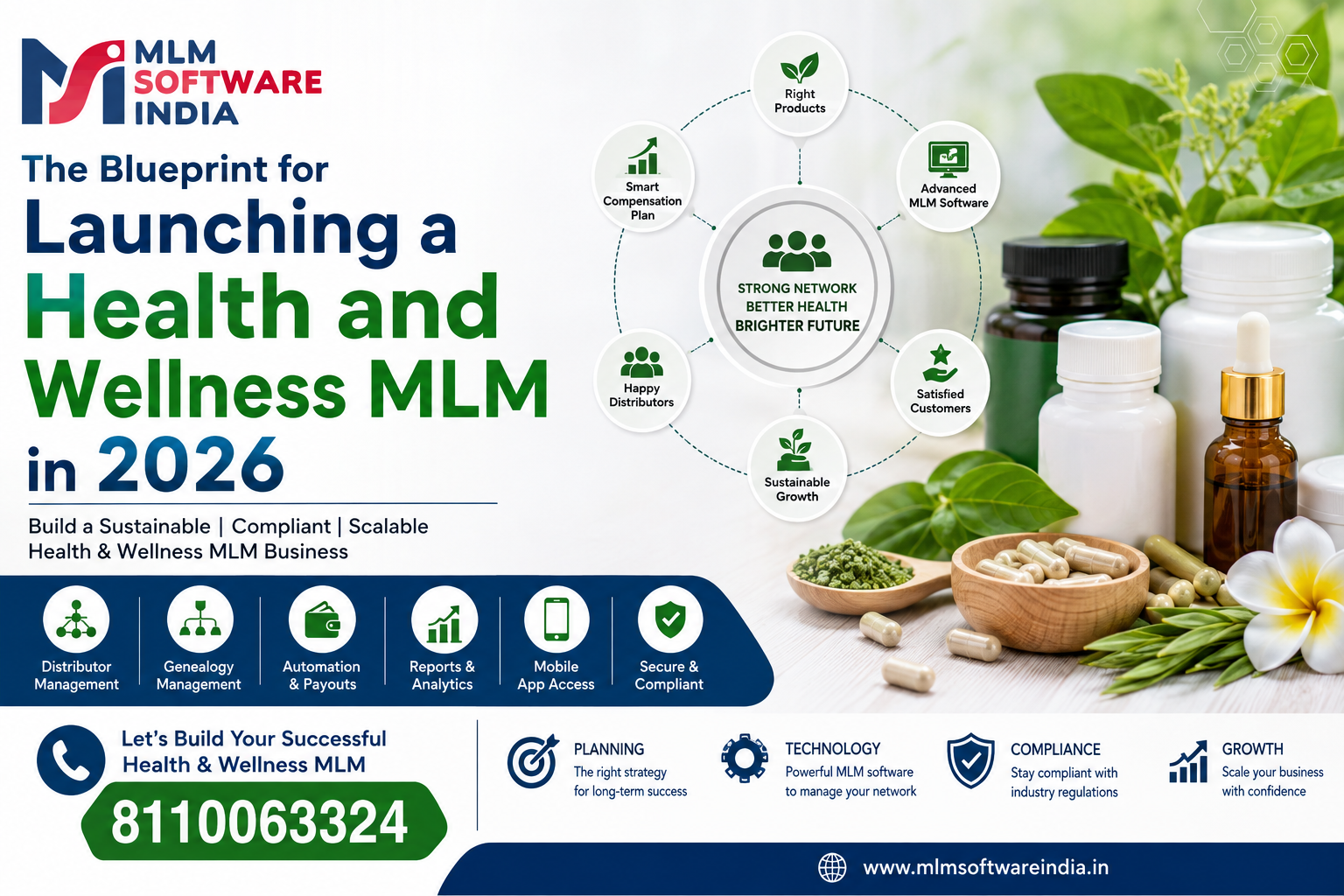
The health and wellness industry continues to expand as consumers become more conscious about nutrition, fitness, preventive wellness, personal care, and healthier lifestyles. For entrepreneurs, this creates an opportunity to build a health and wellness MLM business that combines quality products with a scalable direct selling model.
However, launching a successful MLM business in 2026 requires more than recruiting distributors and selling products. Businesses need a clear compensation structure, reliable technology, regulatory awareness, strong customer support, and a strategy for building long-term trust.
A modern Network marketing software platform can help automate distributor management, commissions, sales tracking, genealogy, reporting, and other essential operations. Businesses targeting the local market can also consider solutions such as MLM software in Idukki to support their technology and network marketing requirements.
This guide explains the major steps involved in launching a health and wellness MLM in 2026.
What Is a Health and Wellness MLM?
A health and wellness MLM is a direct selling business that distributes products through a network of independent distributors or sellers. Products may include nutritional products, personal care items, fitness-related products, wellness products, or other permitted consumer goods.
The business typically generates revenue through product sales while distributors may earn commissions or incentives according to the company’s compensation plan and applicable rules.
The key to building a sustainable MLM is to focus on real products, genuine customer demand, transparent earnings structures, and long-term distributor relationships.
Why Start a Health and Wellness MLM in 2026?
Several factors make the wellness sector attractive for entrepreneurs.
1. Growing Interest in Wellness
Consumers are increasingly interested in nutrition, fitness, personal care, healthy lifestyles, and preventive wellness. This creates opportunities for businesses offering useful and differentiated products.
2. Digital-First Selling
Social media, mobile applications, websites, messaging platforms, and digital payment systems allow distributors to reach customers without depending entirely on traditional sales channels.
3. Personalized Customer Experiences
Modern technology allows businesses to analyze customer behavior, purchase history, and engagement patterns. This can help distributors provide more relevant product information and improve customer retention.
4. Scalable Distribution
A properly designed direct selling model can allow a company to expand into different cities and regions while maintaining centralized control over products, commissions, distributors, and reporting.
Step 1: Define Your Health and Wellness Product Category
Before developing your MLM structure, decide exactly what products you will sell.
Potential categories include:
- Nutritional products
- Fitness and wellness products
- Personal care products
- Natural personal care
- Lifestyle products
- Wellness accessories
- Healthy consumer products
Your product selection should be based on genuine customer demand and a sustainable business model rather than simply choosing products because they are popular.
Product quality, sourcing, packaging, labeling, pricing, customer support, and applicable regulatory requirements should all be considered before launch.
Step 2: Identify Your Target Market
A successful MLM needs a clearly defined target audience.
Consider factors such as:
- Age group
- Location
- Lifestyle
- Purchasing behavior
- Wellness interests
- Product preferences
- Average spending capacity
Instead of trying to sell everything to everyone, develop a clear value proposition for a specific customer segment.
For example, a company could focus on everyday wellness products for working professionals or develop a specialized product range for fitness-conscious consumers.
Step 3: Build a Strong Brand
Trust is extremely important in the health and wellness sector.
Your brand should communicate:
- Product quality
- Transparency
- Reliability
- Customer focus
- Professionalism
- Responsible business practices
Create consistent branding across your website, distributor portal, mobile application, packaging, social media channels, and promotional materials.
Avoid exaggerated health claims or unrealistic income promises. A sustainable MLM business should build its reputation around authentic products and transparent communication.
Step 4: Select the Right MLM Compensation Plan
Your compensation plan determines how distributors are rewarded.
Depending on the business model, companies may consider structures such as:
- Binary plan
- Matrix plan
- Unilevel plan
- Stairstep plan
- Hybrid compensation plan
The best plan is not necessarily the most complicated one. It should be easy to understand, financially sustainable, transparent, and aligned with genuine product sales.
Before launch, model different scenarios to understand how commissions, incentives, bonuses, refunds, product costs, operational expenses, and distributor payouts affect profitability.
Step 5: Develop Reliable MLM Software
Technology is one of the most important components of a modern MLM business.
Manual spreadsheets may work for a small operation, but they become difficult to manage as distributor networks and transactions increase.
A professional MLM platform can automate important processes such as:
- Distributor registration
- Genealogy management
- Placement management
- Commission calculation
- E-wallet management
- Payout processing
- Sales tracking
- Rank management
- Incentive management
- KYC workflows
- Reports and analytics
- Customer management
- Notifications
Businesses looking for technology support in Kerala can explore MLM software in Idukki for building and managing their network marketing infrastructure.
Step 6: Consider Direct Selling Software
A health and wellness company needs more than commission calculations.
Modern direct selling software can connect multiple operational functions into a centralized platform.
For example, distributors can use dashboards to monitor:
- Personal sales
- Team performance
- Orders
- Commission earnings
- Network growth
- Targets
- Rank progression
- Incentives
Administrators can use the same platform to monitor overall business performance.
This reduces manual work and gives management better visibility into the network.
Step 7: Build a Distributor Mobile Experience
Distributors increasingly expect to manage their business from smartphones.
A mobile-friendly MLM platform or dedicated mobile application can provide access to:
- Distributor profiles
- Orders
- Product catalogs
- Genealogy
- Wallet balances
- Commission reports
- Team statistics
- Notifications
- Marketing resources
A convenient mobile experience can improve distributor engagement and reduce dependence on administrative support.
Step 8: Integrate Digital Payments
Digital payments are an important part of modern direct selling.
Depending on your market and business requirements, your technology platform may need integrations for:
- Payment gateways
- Bank transfers
- Digital wallets
- Automated payout processing
- Order payments
- Refund management
The payment workflow should be secure, transparent, and properly documented.
Step 9: Explore Crypto and Blockchain Carefully
Blockchain technology and cryptocurrency continue to attract attention in the network marketing sector.
Some entrepreneurs may consider crypto MLM software in Idukki when developing technology for businesses that legitimately incorporate blockchain-based functionality.
However, crypto-related MLM models require additional caution.
Before implementing cryptocurrency features, businesses should evaluate:
- Applicable laws and regulations
- Tax implications
- Payment compliance
- KYC requirements
- AML obligations where applicable
- Consumer protection requirements
- Security risks
- Cryptocurrency-related restrictions
Crypto should not be added simply as a marketing trend. There should be a legitimate business purpose and appropriate legal and compliance review.
Step 10: Prioritize Compliance
Health and wellness businesses need to pay close attention to product-related and direct-selling requirements.
Depending on the products and business structure, requirements may involve areas such as:
- Product labeling
- Advertising claims
- Consumer protection
- Taxation
- Direct selling regulations
- Data protection
- Product-specific regulatory requirements
Businesses should obtain professional legal and regulatory advice before launching products or compensation programs.
Technology can support compliance workflows, but software itself does not make a business legally compliant.
Step 11: Create a Distributor Training Program
Recruitment alone does not create a successful MLM network.
Distributors need proper training covering:
- Product knowledge
- Ethical selling
- Customer service
- Digital marketing
- Order management
- Compensation plan understanding
- Company policies
- Responsible communication
Create training videos, FAQs, product documentation, webinars, and digital marketing resources that distributors can access through their dashboard.
Step 12: Develop a Customer Retention Strategy
A sustainable health and wellness MLM should not depend entirely on distributor recruitment.
Customer retention should be a major priority.
Track metrics such as:
- Repeat purchases
- Customer retention
- Average order value
- Product popularity
- Refund rates
- Customer satisfaction
- Distributor-generated sales
A customer-centric approach can create recurring revenue and strengthen the foundation of the business.
Step 13: Use Analytics to Improve Performance
Modern Network marketing software can provide valuable business intelligence.
Management can monitor:
- New distributor registrations
- Active distributors
- Sales volume
- Team performance
- Product demand
- Geographic performance
- Commission expenses
- Customer retention
- Distributor activity
These insights can help management identify successful strategies and areas requiring improvement.
Step 14: Create a Digital Marketing Strategy
Your distributors will need a consistent digital marketing strategy.
Potential channels include:
- Search engines
- Social media
- Email marketing
- Video content
- Blogs
- Influencer partnerships
- Educational webinars
- Community marketing
However, health-related marketing should be particularly careful about unsupported claims.
Create marketing guidelines that clearly explain what distributors can and cannot say about products and earnings.
Step 15: Launch With a Pilot Program
Instead of immediately attempting a massive launch, consider starting with a controlled pilot.
A pilot can help you test:
- Product demand
- Distributor onboarding
- Order processing
- Compensation calculations
- Customer support
- Payment workflows
- Software performance
- Training materials
Collect feedback and fix operational problems before expanding the network.
Essential Features of MLM Software for a Wellness Business
When evaluating MLM technology, consider whether your platform provides:
| Feature | Business Benefit |
| Distributor Management | Centralized network administration |
| Genealogy Tree | Easy visualization of distributor structures |
| Commission Engine | Automated compensation calculations |
| E-Wallet | Transparent distributor earnings management |
| KYC Management | Organized verification workflows |
| Product Management | Centralized product and inventory administration |
| Order Management | Efficient sales processing |
| CRM | Customer and distributor relationship management |
| Reports | Better business decision-making |
| Mobile Access | Convenient distributor management |
| Notifications | Faster communication |
| Analytics | Performance monitoring |
Common Mistakes to Avoid
Launching a health and wellness MLM can become difficult if businesses make avoidable mistakes.
Choosing Products Without Market Research
A compensation plan cannot compensate for poor product-market fit.
Making Unrealistic Income Claims
Promising guaranteed or extraordinary earnings can damage trust and create serious compliance concerns.
Overcomplicating the Compensation Plan
If distributors cannot understand how they earn commissions, adoption and trust can suffer.
Ignoring Technology Scalability
A platform should be able to handle growing users, orders, transactions, and reporting requirements.
Focusing Only on Recruitment
Long-term sustainability depends on genuine product demand and customer sales.
Neglecting Data Security
Distributor and customer information must be handled responsibly and protected using appropriate technical and organizational measures.
How to Choose the Right MLM Software Development Company
Before selecting an MLM software provider, evaluate:
- Experience with direct selling businesses
- Compensation-plan flexibility
- Software scalability
- Security architecture
- Mobile support
- Payment integrations
- CRM capabilities
- Reporting and analytics
- Customer support
- Customization options
- API integration capabilities
- Data backup and recovery
- Compliance-supporting features
- Demonstration and testing process
- Long-term maintenance
Ask for a detailed product demonstration rather than making a decision based solely on screenshots or marketing claims.
Frequently Asked Questions
Is health and wellness MLM profitable in 2026?
A health and wellness MLM can become profitable when it has genuine product demand, competitive pricing, effective distribution, controlled operating costs, and a sustainable compensation structure. Profitability is not guaranteed and depends on the business model and execution.
What software is needed to run an MLM business?
A modern MLM business may require MLM software, direct selling software, CRM, e-commerce functionality, payment integrations, reporting tools, mobile applications, and communication systems.
Why is MLM software important?
MLM software automates many operational processes, including distributor management, genealogy, commissions, orders, wallets, reporting, and analytics.
Can MLM software support different compensation plans?
Yes. Depending on the platform, MLM software can be configured for compensation structures such as binary, matrix, unilevel, stairstep, or hybrid models.
Is crypto MLM software suitable for every MLM company?
No. Cryptocurrency functionality should only be considered when it serves a legitimate business purpose and is compatible with applicable laws, regulations, tax requirements, and compliance obligations.
What should I look for in Network marketing software?
Look for scalability, compensation-plan flexibility, security, distributor management, commission automation, reporting, mobile access, integrations, and reliable technical support.
Final Thoughts
Launching a health and wellness MLM in 2026 requires a combination of quality products, responsible business practices, effective technology, distributor support, customer retention, and strong compliance processes.
The goal should not simply be to build a large distributor network. The objective should be to create a sustainable ecosystem where customers receive genuine value, distributors have useful tools, and the company can efficiently manage its growing operations.
Whether you are planning a regional launch or building a business for a wider market, investing in reliable MLM software in Idukki, direct selling software, or specialized Network marketing software can provide the technological foundation needed to manage a modern direct selling business.
For businesses exploring blockchain-based models, crypto MLM software in Idukki may also be considered, but only after carefully evaluating the legal, regulatory, tax, security, and consumer-protection implications.
With the right products, transparent compensation structure, scalable technology, ethical marketing, and customer-first strategy, a health and wellness MLM can build a stronger foundation for sustainable growth in 2026 and beyond.