
Kerala is widely recognized for its highly literate populace, robust consumer awareness, and stringent regulatory frameworks. For forward-thinking entrepreneurs, the direct selling industry in this southern Indian state represents an incredible opportunity, provided it is executed with absolute adherence to the law. With the implementation of the Central Consumer Protection (Direct Selling) Rules, 2021, and the highly structured State Level Monitoring Mechanism established by the Kerala Government, the days of unregulated networking schemes are definitively over.
Today, launching a legitimate enterprise in Kerala requires a precise blend of ethical product distribution, rigorous legal compliance, and cutting-edge digital infrastructure. This comprehensive guide walks you through the essential steps to build a sustainable, legally sound, and technologically advanced direct selling business in God’s Own Country.
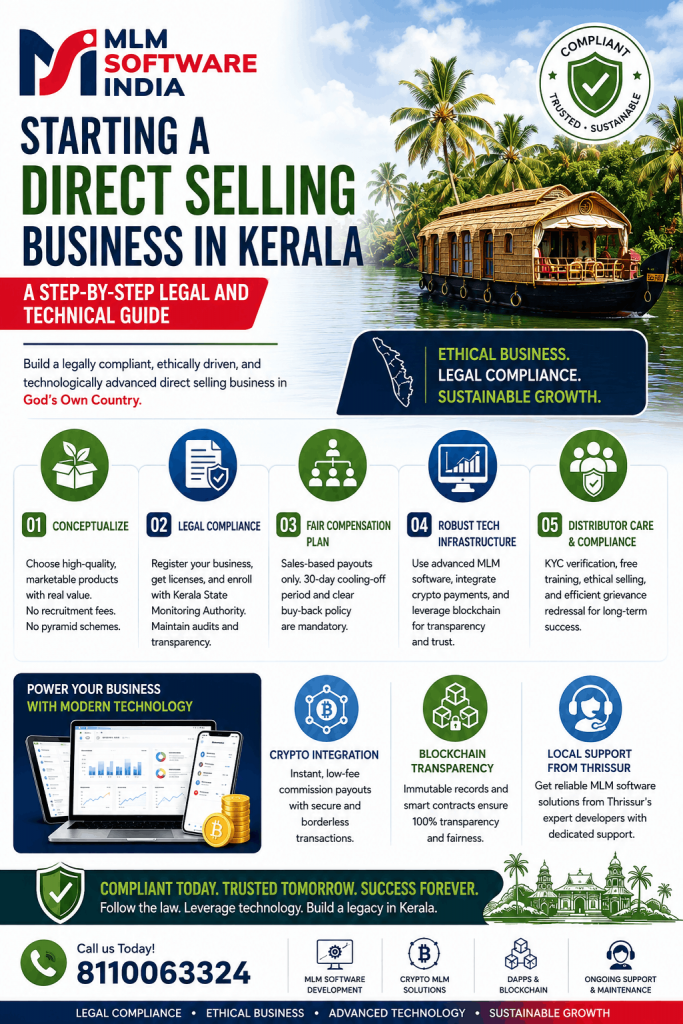
Step 1: Conceptualizing Your Product Line and Business Model
The foundational pillar of any viable direct selling business is the intrinsic value and quality of its products or services. Under Indian law and Kerala’s strict monitoring guidelines, your revenue must be generated solely from the actual sale of goods or services to end consumers, never from recruitment fees or headhunting.
- Focus on Marketable, High-Quality Products: Kerala boasts a discerning consumer base that values authenticity. Whether you are dealing in Ayurvedic wellness supplements, organic cosmetics, agricultural technology, or educational services, your products must solve real problems and be priced competitively against the traditional retail market.
- Strict Prohibition of Pyramid Schemes: The law makes a crystal-clear distinction between legitimate direct selling and illegal money circulation schemes under the Prize Chits and Money Circulation Schemes (Banning) Act, 1978. You cannot require new distributors to pay exorbitant entry fees or purchase massive amounts of non-returnable inventory just to join.
Step 2: Navigating Legal Registrations and State Compliance
Operating a direct selling entity in Kerala demands strict adherence to both Central regulations and specific state protocols enforced by the Department of Civil Supplies and Consumer Affairs.
Mandatory Business Incorporations and Licenses
You must establish a registered legal entity, such as a Private Limited Company or a Limited Liability Partnership (LLP). From there, you need to secure specific registrations:
| Registration Type | Purpose and Compliance Necessity |
| PAN and TAN | Necessary for corporate banking and managing Tax Deducted at Source (TDS) on all commission payouts. |
| GST Registration | Mandatory for the legal sale of goods and services within Kerala and across India. |
| FSSAI and AYUSH Licenses | Non-negotiable if your portfolio involves food items, nutritional supplements, or Ayurvedic formulations. |
| Legal Metrology | Crucial for packaged commodities to ensure accurate labeling of weights, measures, and Maximum Retail Price (MRP). |
Kerala State Monitoring Authority
No entity can engage in direct selling in Kerala without officially enrolling with the State Monitoring Authority. You must file a comprehensive application detailing your promoters, business plan, and financial health. Your corporate website must prominently display your Certificate of Incorporation, compensation plan, product pricing, GST returns, and a clear return policy.
Financial Audits and Reporting
Regular internal and external audits are necessary to remain in good standing. You must maintain accurate books of accounts, stock records, and transaction logs. Furthermore, the State Monitoring Authority has the right to demand copies of Income Tax and GST returns to assess the applicant’s financial stability and sustainability.
Step 3: Designing a Legally Compliant Compensation Plan
Your compensation plan is the mathematical engine driving your sales force. Whether you implement a Binary, Unilevel, or Matrix structure, it must be inherently fair and legally sound.
- Sales-Based Remuneration: Ensure your algorithm restricts payouts exclusively to the movement and sale of products.
- The Mandatory Cooling-Off Period: Kerala’s guidelines explicitly require you to provide a 30-day “cooling-off” period. If a newly enrolled distributor decides the business is not right for them within this timeframe, they have the absolute legal right to return any purchased goods in marketable condition and receive a full refund.
- Buy-Back Policy: Your business must clearly outline a buy-back policy for unsold, commercially marketable goods.
Step 4: Building a Robust Technical Backbone
You cannot manage a modern direct selling operation using outdated spreadsheets. As your network grows across districts like Ernakulam, Thiruvananthapuram, and Kozhikode, enterprise-grade technology becomes absolutely critical to track real-time sales and manage inventory.
Choosing the Right Software Architecture
Operating at scale requires implementing highly secure direct selling software to handle complex, multi-tiered commission structures accurately and without manual errors. A reliable Network marketing software suite will automate your compliance workflows, including TDS deductions, GST invoicing, and distributor payout tracking.
When sourcing this vital infrastructure, you do not need to look beyond Kerala itself. Sourcing mlm software in Thrissur has become incredibly popular for direct selling startups across South India. Thrissur’s IT ecosystem is renowned for producing specialized, cost-effective, and highly secure platforms tailored specifically to the nuances of the multi-level marketing industry. Partnering with local tech talent ensures you get a robust system with easily accessible technical support.
Future-Proofing with Web3 Technology
As the global marketplace digitizes, forward-thinking direct selling businesses are looking beyond traditional fiat payment gateways to attract a modern demographic.
- Cryptocurrency Integration: Implementing Crypto mlm software allows you to facilitate seamless, borderless transactions. It enables instant, low-fee commission payouts using stablecoins or other digital assets, removing the friction of traditional banking delays. This is highly appealing to a younger, tech-savvy distributor base.
- Blockchain Transparency: To build absolute trust and prove that your compensation plan is immutable and mathematically fair, consider partnering with a specialized Dapp development company. By utilizing decentralized applications (DApps) and smart contracts on a blockchain network, your commission payouts can be entirely automated and recorded on a public ledger. This level of cryptographic transparency is unparalleled, proving to both your distributors and Kerala’s regulatory bodies that your business operates with 100% financial integrity.
Step 5: Distributor Onboarding and Grievance Redressal
Your direct sellers are the public face of your brand. Kerala’s regulations dictate strict protocols regarding how you must interact with, train, and manage your sales force to prevent mis-selling and deceptive consumer practices.
Regulatory Note on Mis-selling: The Consumer Protection Rules define “mis-selling” as selling a product by misrepresenting it to successfully complete a sale, including providing misleading information or omitting key details that make the product appear to be something it is not. This is strictly prohibited.
- Rigorous KYC and Documentation: You are legally required to maintain a verified “Register of Direct Sellers.” Before a distributor is authorized to sell a single product, you must verify their Identity Proof, Address Proof, and PAN card. You are also required to issue them a proper physical identity card.
- Mandatory Orientation and Training: Entities must provide comprehensive orientation sessions to all prospective direct sellers completely free of charge. These programs must honestly and accurately explain the remuneration system, product details, and the ethical code of conduct required in the field.
- Efficient Grievance Redressal: You must appoint a dedicated, accessible Grievance Redressal Officer. Every complaint—whether originating from a distributor or a retail consumer—must be systematically logged, assigned a unique tracking ticket, acknowledged within 48 hours, and legally resolved within a maximum of 45 days.
- Marketing and Promotional Control: Kerala’s guidelines are exceptionally strict regarding deceptive marketing. You must strictly prohibit your sales force from making exaggerated income claims, showcasing unrealistic lifestyle promises, or making unapproved medicinal claims about your products.
Establishing a highly profitable direct selling enterprise in Kerala is a remarkably rewarding venture when approached with meticulous planning and an unwavering commitment to legal standards. By strictly adhering to the Consumer Protection Rules, respecting the State Monitoring Mechanism, and leveraging the robust IT infrastructure available locally, you can build a highly scalable and respected business. Embrace modern technological advancements and prioritize absolute consumer protection, and your direct selling venture will be perfectly positioned for long-term, sustainable success.